LinkedIn Drip Campaign: How to Start More Relevant Sales Conversations

Your prospect accepted your connection request. Three minutes later, they received a product pitch. Two days later, a reminder. Then another message asking whether they had seen the reminder.
The sequence worked perfectly. The conversation never started.
A LinkedIn drip campaign needs more than scheduled messages. It needs a reason for each message, space for the prospect to respond and rules that change what happens next. Otherwise, you have built a calendar for being ignored.
Here is how to create a sequence that earns attention and gives your team something useful to work with.
What is a LinkedIn Drip Campaign?
A LinkedIn drip campaign is a planned sequence of outreach messages delivered over time. Each step follows a delay, an action or a condition, such as a prospect accepting your connection request.
A basic sequence might include a connection request, an opening message, a useful follow-up and a final check on relevance.
The sequence should adapt to responses. Someone who replies needs a conversation. Someone who declines needs to leave the campaign.
LinkedIn drip marketing applies this approach to building familiarity over several interactions. A LinkedIn outreach campaign usually has a more immediate objective, such as starting a sales conversation or following up after an event. In practice, these approaches overlap.
Start With the Situation Your Prospect Recognises
Before writing anything, finish this sentence: “This campaign is for people who are dealing with…”
“Sales leaders” is an audience label. “Sales leaders managing LinkedIn and email outreach across separate tools” describes a situation you can write about.
Build your list around that distinction. Consider role, company type, market and a relevant business trigger. A hiring announcement, event attendance or public discussion can provide context when it genuinely relates to your offer.
Do not turn a weak observation into a confident assumption. A company hiring salespeople does not prove its pipeline is struggling. Describe what you can verify and ask about what you cannot.
Give the Campaign One Clear Job
A single sequence cannot introduce your company, explain every feature, qualify the buyer and close the sale in four messages.
Choose one next step. For a cold audience, that could be a reply confirming whether a particular problem exists. For event contacts, it might be permission to send a relevant resource.
Define success before launch. If your objective is a useful conversation, measure positive replies and qualified discussions. A connection acceptance alone does not tell you whether someone wants to buy.
Keep the offer small enough to answer without opening a calendar.
A LinkedIn Drip Campaign Example
The following sequence is illustrative. Its timing is a starting point to test with your audience, rather than a universal schedule. Here, the sender offers an outreach workflow review.
Step 1: Send A Relevant Connection Request
“Hi Maya, your post about managing outbound across a growing team caught my attention. I work on outreach workflows and would like to connect.”
Use this wording only when the post exists and you have read it. Invented familiarity is a poor opening move.
Step 2: Ask One Focused Question
After acceptance, allow a couple of working days before opening the conversation:
“Thanks for connecting, Maya. When someone replies on LinkedIn, how does your team stop the email follow-ups already queued for them?”
The question gives the prospect a specific situation to respond to. It also helps establish whether your offer is relevant.
Step 3: Add Something Useful
If there is no reply, wait several working days before sending a practical observation:
“One thing worth checking: whether a reply stops follow-ups across every channel or only the channel where it arrived. Happy to share a short checklist for reviewing that handoff.”
This message contributes a useful check. Have the checklist ready before offering it.
Step 4: Close the Sequence Politely
After another reasonable gap, finish with a message that makes declining easy:
“I’ll leave this here, Maya. If reviewing your outreach handoffs becomes relevant, I can send the checklist. Otherwise, I’ll close the loop.”
Then stop. A closing message loses its meaning when another follow-up arrives on Thursday.
Build Response Rules before Adding More Steps
Message timing matters. Response handling determines whether the sequence behaves sensibly.
Before launch, decide what happens when someone accepts, replies, declines or asks to reconnect later. Assign an owner for responses and make the next action visible to the team.
A positive reply should pause the sequence while a person takes over. A request for no further contact should trigger your exclusion process. A timing objection should become a dated follow-up task, with the prospect’s context attached.
For multichannel campaigns, check that replies stop scheduled outreach across channels. Nobody wants to explain that they already answered the same question somewhere else.
Personalise the Reason for Reaching Out
A first name and company field are useful formatting. They do little to explain why you chose this person.
Effective personalisation connects a verified detail to a relevant question. Reference a topic they discussed, an event you both attended or a responsibility associated with their role.
Keep that connection proportionate. You do not need three sentences praising a profile before asking one practical question.
AI can help draft variations and shorten messages. Review its output for accuracy, relevance and tone before approving it. Your prospect should recognise their situation in the message.
Measure Conversations and Inspect the Messages
Review connection acceptance, total replies, positive replies, qualified conversations and meetings where relevant. Define each metric consistently so comparisons mean something.
Read the actual responses alongside the dashboard. “Wrong person” suggests targeting needs attention. Repeated questions about your offer suggest the message needs clarity. Positive conversations without meetings may point to the next step you propose.
Test one meaningful change at a time. Compare opening questions or offers while keeping the audience reasonably consistent. Small samples provide clues rather than reliable proof of a winning formula.
Check the Campaign Before Launch
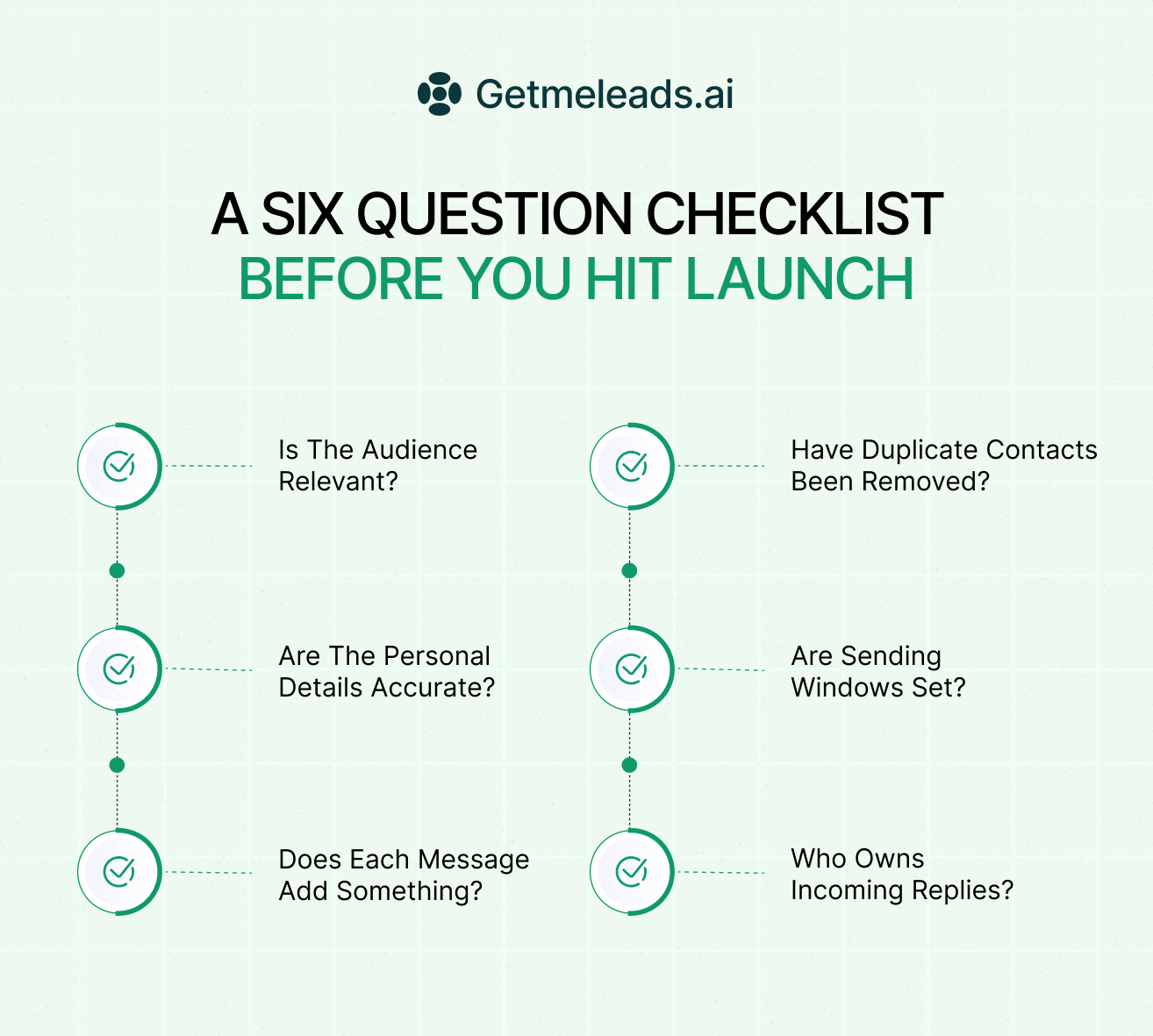
Read the sequence as if you were receiving it between meetings. Can you understand the reason for contact immediately? Does each follow-up add anything? Is the requested action clear?
Preview every personalised field and its fallback. Remove existing customers, active opportunities and anyone already approached by a colleague. Check the sender, audience time zone and response ownership.
Finally, review the full sequence together. Four individually reasonable messages can still sound repetitive when placed beside one another. Give someone outside the campaign a chance to read it aloud first.
Keep the Workflow Connected With Get Me Leads
Get Me Leads brings prospect lists, campaign building, LinkedIn and email outreach, replies and reporting into one workspace.
Its visual canvas supports delays and conditions, including connection acceptance and replies. Smart Follow-up sends another message only when the lead has not replied. AI-generated messages are held for review before sending.
Unibox brings replies together, while the lead record shows the exact messages sent. Managers can inspect the conversation behind the numbers.
LinkedIn prohibits unauthorised automated activity. Account controls do not guarantee protection against restrictions. Review LinkedIn’s rules before choosing your sending approach.
Your next campaign starts with a better question. Build the list, write the sequence and review every step before launch. Book a Get Me Leads demo to see the workflow.